4 min read
Posted
Tuesday, March 3, 2026
at 3:17 PM AST
Posted by
Categories

Upgrading a hospital is never as simple as replacing old equipment. At the Cape Breton Regional Hospital (CBRH), new expansions are taking shape and being thoughtfully integrated into the existing hospital so clinical teams can deliver patient care when they open.
“You don’t get the option to shut down – patient care comes first,” said Ian McDiarmid, director of infrastructure and planning with the CBRM Healthcare Redevelopment Project. “Every improvement has to happen while patients are being treated, surgeries are underway and staff rely on critical systems every minute of the day."
That reality is what shaped the Complex Services Switchover Master Plan (CSSMP) – a carefully sequenced strategy for connecting new utility services from a nearly complete, new energy centre into a fully occupied, operational hospital.
“Electricity, heating and cooling are not background systems in a hospital. They are critical to providing patient care,” he said. “That’s why our project team has built the CSSMP around early testing, verification and validation – long before permanent changeovers take place.”
At CBRH, electrical power is supplied through both primary and secondary feeds, ensuring continuity if one source is unavailable. Rather than waiting for a real outage to test the backup systems, the project team decided to test the hospital’s secondary 12.5 kV electrical feed under controlled conditions.
Kevin Carey, is a project manager with the CBRM Health Care Redevelopment Project. He says the CSSMP focuses on proving the existing infrastructure does what it’s supposed to do, when required.
“Proactively mitigating risks on a complex project is critical to project success. Prior to major electrical and mechanical switchovers happening actions are taken to identify issues in a controlled environment.” Carey said. “Those lessons are now being fed directly back into future planning, strengthening both the system and the confidence of everyone who relies on it.”
Carey was part of a recent test at CBRH that was planned well in advance, co-ordinated closely with hospital leadership and scheduled at 3 a.m. – during periods of lower patient activity. The goal was to minimize risk and interruptions to staff and patients, while gaining real-world confirmation of system performance.
Electrical systems aren’t the only area being tested. The CSSMP also involves connecting new mechanical systems – pipes carrying heating and cooling water – from the energy centre into the existing hospital.
“In theory, a piping drawing can tell you what should happen,” McDiarmid said. “But in an older, active hospital, theory isn’t enough. To remove that uncertainty, we identified future tie-in points and exercised them to confirm they operate as intended. We don’t want to discover these things during a live tie-in. We’re discovering them months in advance, so we can plan and mitigate.”
In a fully occupied hospital, the best infrastructure upgrades are the ones no one notices. Power transfers need to be predictable, and contingency plans should exist before they’re needed.
“In healthcare, success often looks like nothing happened,” Carey said. “At CBRH, that quiet success is exactly the goal. Through proactive planning, the CSSMP project helps ensure that major infrastructure upgrades happen safely, responsibly and without impacting patient care.”
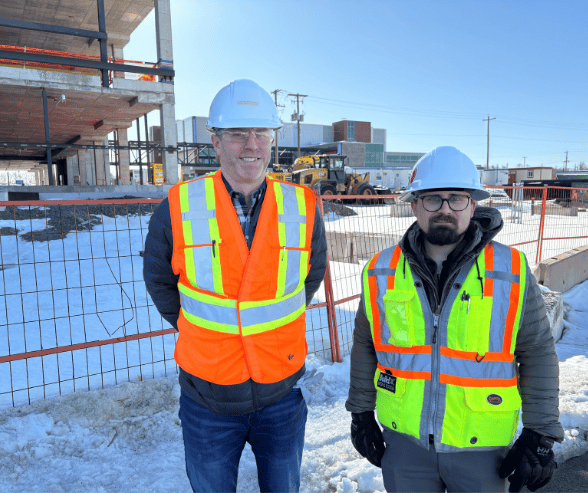
Photos of (1) the CBRM Health Care Redevelopment Project site and (2) (L-R) Ian McDiarmid, Director of Infrastructure and Planning with Kevin Carey, Project Manager.